What Is the Bitcoin Halving and How Does It Work: When Is the Next One
What the Bitcoin halving is, how often it happens, how much the block reward falls, why it matters for supply and what cannot be predicted. A simple explanation.
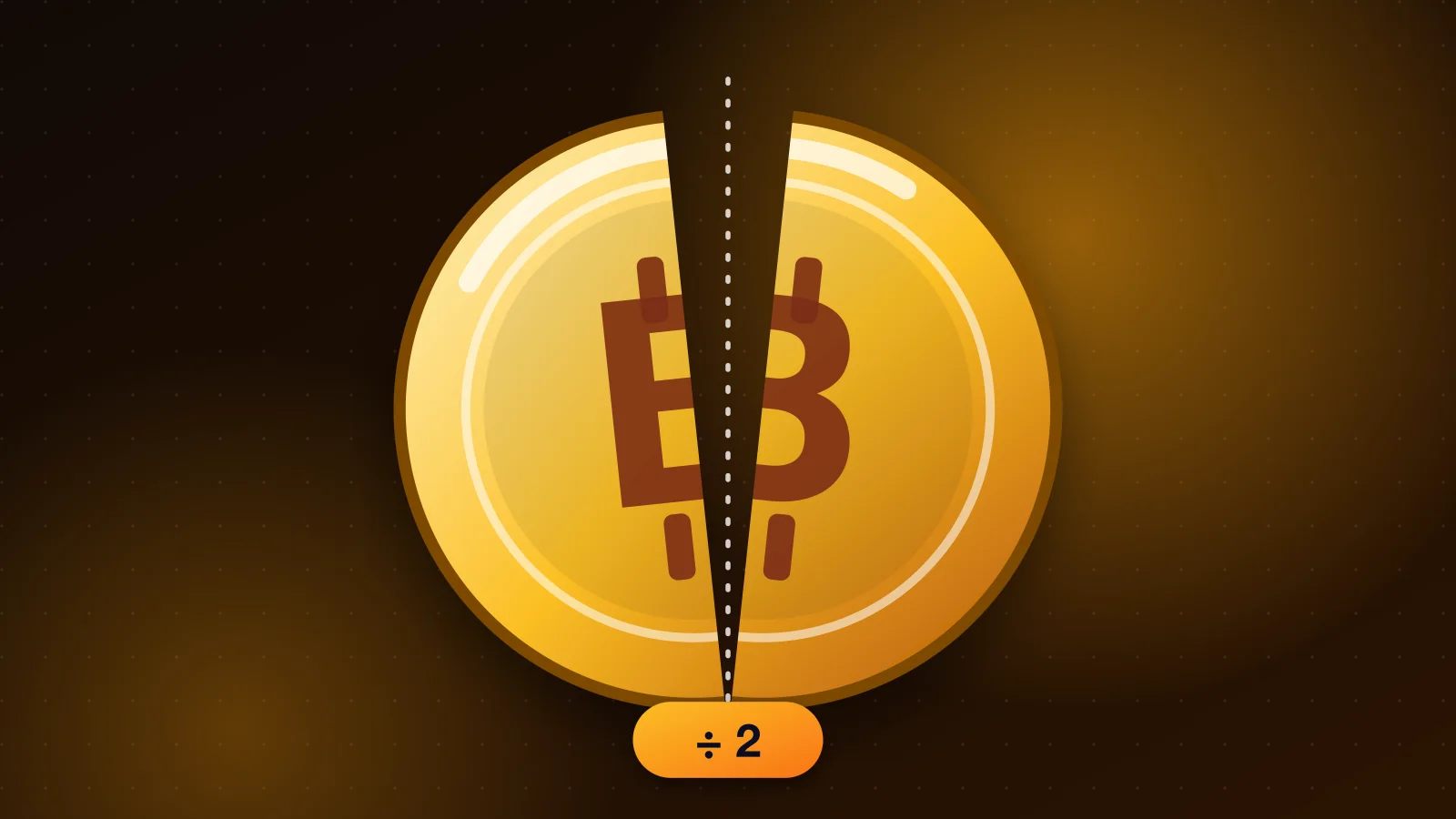
In short: the halving is an event in which the miners' reward for a new Bitcoin block is cut in half. It happens roughly every four years (after 210,000 blocks). The last one took place in April 2024, when the reward fell from 6.25 to 3.125 BTC. The halving slows the creation of new bitcoins, but it does not determine the price.
How Bitcoin is created
New bitcoins are created by mining. Miners verify transactions and for every block they find they receive a reward in newly created bitcoins, plus fees. The total supply is capped at 21 million BTC, which is one of Bitcoin's core properties.
What the halving is
After every 210,000 blocks the block reward is cut in half. A block is found roughly every ten minutes, so a halving happens about once every four years. This gradually slows the creation of new bitcoins until the last one is mined around the year 2140.
History of the reward
| Period | Reward per block |
|---|---|
| 2009 to 2012 | 50 BTC |
| 2012 to 2016 | 25 BTC |
| 2016 to 2020 | 12.5 BTC |
| 2020 to 2024 | 6.25 BTC |
| since April 2024 | 3.125 BTC |
The next halving is expected around 2028, when the reward will fall to 1.5625 BTC. The exact date depends on how fast blocks are mined.
What the halving means for the price
In theory, slower creation of new coins at the same demand supports the price. In the past prices often rose after a halving, but it is neither a law nor a guarantee. The price is driven by demand, regulation, the macro environment and market mood, and the halving is known long in advance and already priced in by the market. There is no rule that the price always rises after a halving.
Impact on miners
After a halving miners receive fewer bitcoins for the same work. Less efficient miners may stop mining, which in the past led to a temporary drop in network power. That is why transaction fees and the efficiency of the equipment matter to miners. You can follow the network's hashrate and difficulty on our hashrate and difficulty pages.
What to do about it as an investor
- Do not bet on timing. Buying regularly (dollar-cost averaging) is simpler.
- Follow the current Bitcoin price and the on-chain data.
- Remember taxes: the rules depend on the country you live in.
Common myths about the halving
- "The price doubles after the halving." No law says so. The price depends mainly on demand and the surrounding conditions.
- "The halving reduces the number of bitcoins." It does not. It only slows the creation of new ones. The supply still approaches 21 million.
- "The halving is unpredictable." The date is known long in advance because it is set by the number of blocks, and the market takes it into account.
- "Miners quit after the halving." Some less efficient ones may stop, but the network adapts and mining becomes more dependent on fees.
How to follow the halving
The current price, changes over various periods and a chart from 4H to MAX are on the Bitcoin page. The state of the network, fees and hashrate are shown on the mempool and hashrate pages.
What this means for you as an investor
- The halving is one piece of information among many, not a buy signal.
- Bitcoin's price has swung by tens of percent in the past, so size your investment accordingly.
- Regular buying (DCA) needs less guessing than trying to hit the right moment.
- Choose an amount so that you are not forced to sell during a drop.
For a comparison with the second largest network see Bitcoin vs Ethereum, and for the basics of the technology What is a blockchain.
Frequently asked questions
When was the last halving?
In April 2024. The reward fell to 3.125 BTC per block.
When is the next halving?
Roughly around 2028. The exact time depends on how fast blocks are mined.
Does the price always rise after a halving?
No. History shows prices often rose, but it is not a guarantee and every cycle has different conditions.
How many bitcoins are still to be mined?
Most of the 21 million already exist. The rest will be created ever more slowly until about 2140.
For information only, not investment advice. Cryptocurrencies are very risky and their prices swing sharply.