Bitcoin vs Ethereum: How They Differ and Which Suits You
Bitcoin compared with Ethereum: purpose, technology, coin supply, fees, risks and the role in a portfolio. Who each is suited for and how to follow their prices.
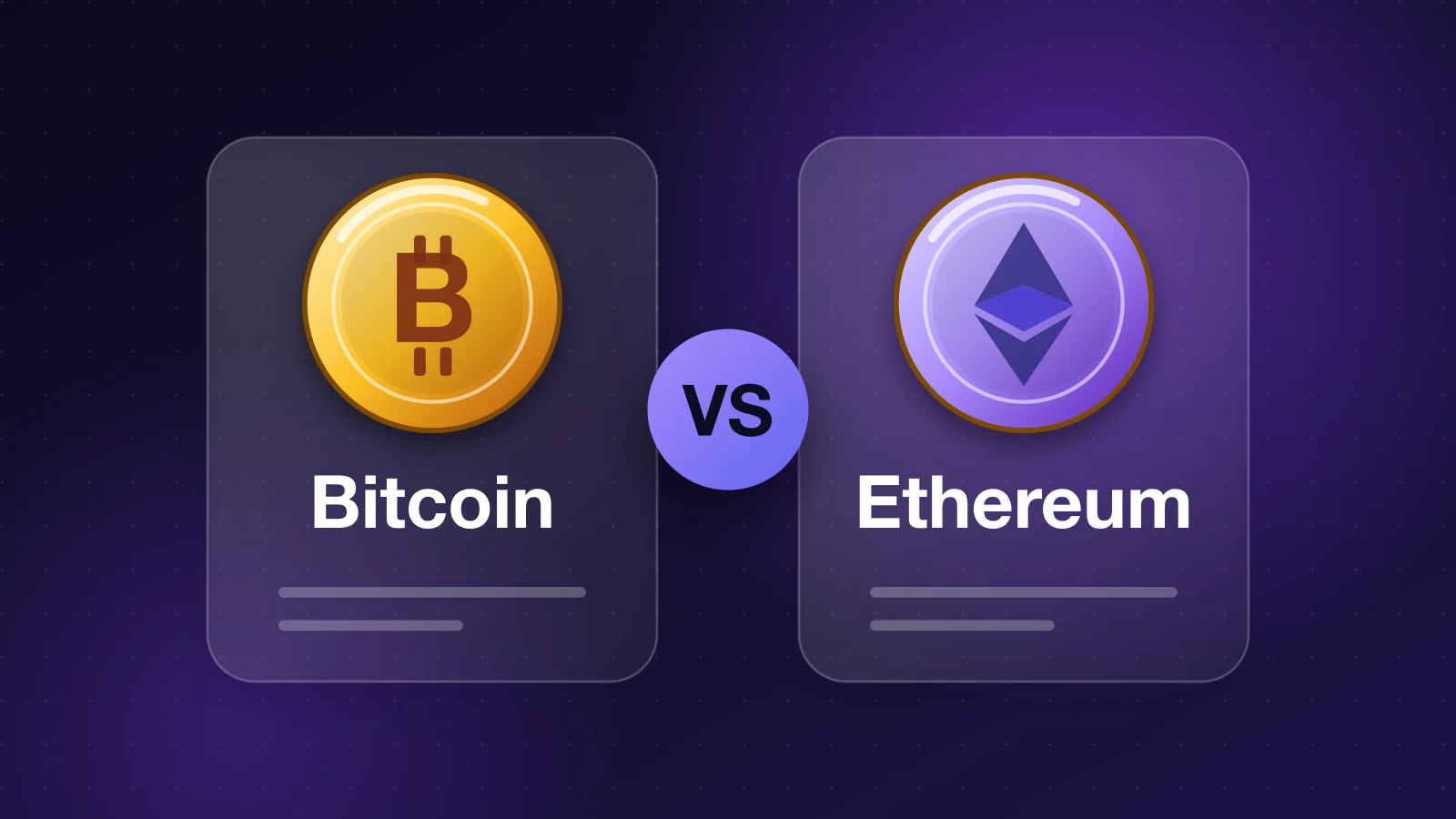
In short: Bitcoin is mainly a digital store of value with a fixed supply of 21 million coins. Ethereum is a platform for smart contracts and decentralized applications, and its coin ETH is used to pay fees and for staking. They differ in purpose and in risk. Both are very volatile.
Side by side
| Bitcoin (BTC) | Ethereum (ETH) | |
|---|---|---|
| Main purpose | store of value, payments | platform for applications and smart contracts |
| Supply | fixed cap of 21 million | no fixed cap |
| Consensus | proof of work (mining) | proof of stake |
| Staking | no | yes |
| Smart contracts | limited | extensive |
| Riskiness | high | high |
Bitcoin
Bitcoin was created in 2009 as decentralized digital cash. Today it is most often seen as "digital gold". Its rules change only rarely and new coins are created on a fixed schedule with a halving, see What is the Bitcoin halving. The current price is on the Bitcoin price page, and the network's health on the on-chain data pages.
Ethereum
Ethereum (2015) extended the idea of the blockchain with smart contracts. It is the foundation of a large part of decentralized finance, tokens and NFTs. Since 2022 it has used proof of stake, so ETH holders can stake, see What is staking. The ETH price is on the Ethereum price page. A comparison with a competitor is in Solana vs Ethereum.
Risks of both
- The price swings sharply. A fall of tens of percent in a short time is normal.
- Regulation is evolving and can affect the price.
- Technical risks and scams around the space, see How to spot a crypto scam.
- Custody. On an exchange you do not own the keys; larger amounts belong in your own wallet.
Which is more suitable
There is no universal answer. Bitcoin is the simpler story (limited supply), Ethereum is a bet on the success of a platform. Many people hold both in a proportion that matches their own risk tolerance. Crypto should make up only a small part of your wealth, see Portfolio diversification.
How to buy
- Choose a regulated exchange available in your country and check its fees.
- Buy regularly, for example through dollar-cost averaging (DCA), rather than trying to time the market.
- Keep records of your trades for tax purposes. The rules depend on your country.
Frequently asked questions
Is Ethereum better than Bitcoin?
They are not the same. Bitcoin is focused on storing value, Ethereum on applications. Which is "better" depends on your goal and risk tolerance.
Can I stake Bitcoin?
Not directly, Bitcoin uses mining. Staking is possible on proof of stake networks such as Ethereum.
How much Bitcoin and Ethereum should I buy?
Only an amount you can afford to lose. The split is individual and is not a recommendation.
An informational comparison, not investment advice. Cryptocurrencies are very risky and their prices swing sharply.