Compound Interest: How It Works and Why It Matters So Much in Investing
What compound interest is, what it looks like in examples ($100,000, $5,000 a month), why time and regularity decide and how fees and inflation affect the result.
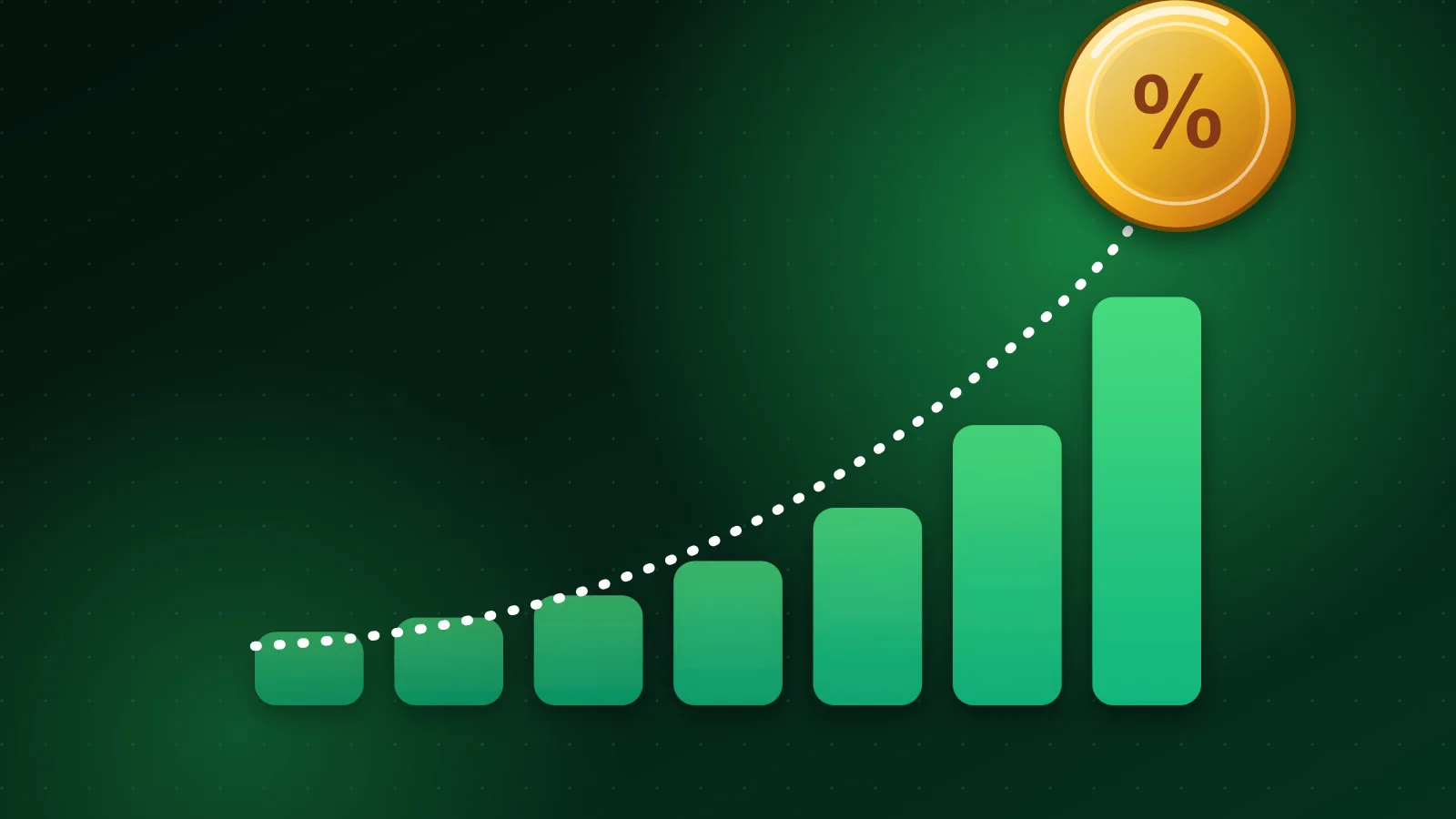
In short: compound interest means that returns earn further returns. The longer you let money work, the steeper the growth. Time, regularity and low fees decide the result. The examples below are only calculations assuming a constant rate of return. Real returns fluctuate and are not guaranteed.
How compound interest works
With simple interest you receive a return only on the original amount. With compound interest the return is added to the capital and in the next period it earns interest too. The formula is simple:
Final amount = starting amount × (1 + annual return) ^ number of years
Example 1: a one-off $100,000
At a constant return of 7% a year, $100,000 would become:
| After | Value |
|---|---|
| 10 years | about $196,700 |
| 20 years | about $387,000 |
| 30 years | about $761,200 |
Notice that the second ten years add more than the first ten, and the third more than the second. That is the power of compounding.
Example 2: $5,000 every month
At a constant return of 6% a year and a regular monthly deposit of $5,000:
| Period | Deposited | Value (at 6% a year) |
|---|---|---|
| 10 years | $600,000 | about $819,000 |
| 20 years | $1,200,000 | about $2,310,000 |
| 30 years | $1,800,000 | about $5,023,000 |
After 30 years more than half of the final amount comes from returns, not from your deposits. This is an illustrative calculation: markets do not rise evenly and fall in some years. The amounts are only illustrations of the principle, in any currency.
What influences the result most
- Time. Every extra year means significantly more. That is why it pays to start early, even with a small amount.
- Regularity. Regular deposits add new capital that also grows.
- Fees. A fee of 1% a year on your assets shows up over 30 years as tens of percent of the result. That is why you should watch the TER of funds, see What is an ETF.
- Reinvestment. Returns and dividends must stay invested, otherwise the compounding is not compound.
- Inflation. The real value matters. At 3% inflation a year, 100,000 has the purchasing power of about 74,400 in today's money after ten years.
Compound interest works against you too
The same principle applies to debts. A debt with a high interest rate, such as an overdraft or a consumer loan, grows faster than most investments would earn. That is why it is sensible to repay expensive debts first.
How to use it
- Start right away, even with a small amount.
- Invest regularly and do not touch the money during declines, see What is a bear market.
- Choose a cheap broad ETF.
- Spread the risk, see Portfolio diversification.
Frequently asked questions
What return can I realistically expect?
Nobody can guarantee it. Stock returns fluctuate and are negative in some years. The examples only explain the principle, they are not a forecast.
Is it better to start earlier with a smaller amount or later with a larger one?
Time usually wins. Money invested earlier has more years to grow, so starting early pays even with a small amount.
How is compound interest calculated?
You multiply the starting amount by (1 + annual return) raised to the number of years. For regular deposits the calculation is repeated for each deposit.
Does compound interest apply to a savings account too?
Yes, if the interest is added to the deposit and earns interest in turn. But savings account returns differ from stock returns and change with rates.
Informational calculations with an assumed constant return, not a forecast or investment advice. Investing is risky and you can lose part or all of your investment.